June, 2016
Men's Health Week: A Look at High Blood Pressure
National Men’s Health Week, celebrated every year during the week leading up to and including Father’s Day, it is important to remind ourselves and be aware of the health risks that affect the men in our lives. These risks encompass a wide range of conditions including high blood pressure stroke, heart failure, heart attack, and kidney failure, among others. National data show that men below the age of 45 are more likely than their female counterparts to have high blood pressure and heart disease is the leading cause of death among men in this country1. The Community Health Data Base (CHDB) collects information on health conditions that could have an impact on these diseases. The following data are from PHMC’s 2015 Southeastern Pennsylvania Household Health Survey.
High Blood Pressure in Southeastern Pennsylvania
In the 2015 Household Health Survey, respondents were asked whether they “have ever been told by a doctor or other health professional that they have high blood pressure or hypertension”. What we have found over the last fifteen years asking this question is that there has been a fairly consistent and steady rise in the number of individuals with high blood pressure, particularly men. As show on Figure 1, more than one-third of men in SEPA have high blood pressure. This percentage has increased since 2000 from 26.3%. The data also show that there are some differences are some differences when examining high blood pressure for men by race/ethnicity.

The data show that slightly more than four in ten (43.8%) black men in SEPA have been told by a doctor that they have high blood pressure, followed by white men (33.6%) and Asian men (16.7%).
Sodium Awareness
Being aware of and watching salt intake is considered an important part of preventing and managing, high blood pressure. In the 2015 Household Health Survey respondents were asked the following two questions: “Are you currently watching or reducing your sodium or salt intake” and “In your opinion, how harmful, to your health is eating too much salt/sodium”.
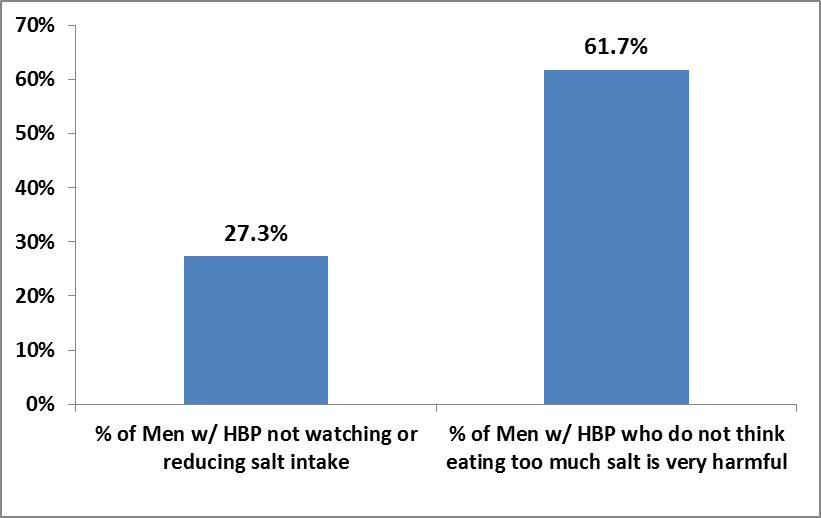
The data show that over one-quarter (27.3%) of men with high blood pressure are not currently watching or reducing their salt consumption. In addition, six in ten men with high blood pressure in SEPA do not think that eating too much salt is very harmful to their health.
For information regarding PHMC’s Community Health Data Base and the 2015 Southeastern Pennsylvania Household Health Survey, or to learn more about high blood pressure data or other men’s health indicators, please contact the CHDB at This email address is being protected from spambots. You need JavaScript enabled to view it. or by phone at 215-985-2521.
____________________________________________________________________________________
- http://www.nhlbi.nih.gov/health/healthtopics/topics/hbp.