National Health Center Week: August 9-15, 2015
July/August 2015
This month’s article is in honor of National Health Center Week, August 9-15, 2015. Health centers are local, non-profit or government-run primary care providers operating in medically underserved neighborhoods. For almost 50 years, these health centers have provided high-quality, affordable primary and preventive care, as well as dental, mental health, substance abuse, and pharmacy services. The second week of August is dedicated to celebrating the services and contributions of Community, Migrant, Homeless and Public Housing Health Centers. Also known as Federally-Qualified Health Centers (FQHCs), they are located in areas where needed care is scarce, and improve access for millions of Americans regardless of their insurance status or ability to pay. Health centers also reduce costs to health systems; the health center model of care has been shown to reduce the use of costlier providers of care, such as emergency departments, specialists and hospitals. Today, over 1,200 health centers deliver care to over 22 million people at over 9,000 delivery sites in the nation.1 Locally, there are 51 health centers in Southeastern Pennsylvania, including 44 sites in Philadelphia and seven in the four suburban counties surrounding the City.These centers serve more than 280,000 adults and children annually. Philadelphia’s health centers create over 1,100 full time jobs and have a $202 million impact on the City’s economy.2
Who Are Health Center Patients?
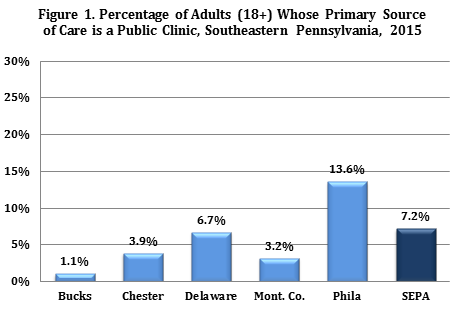
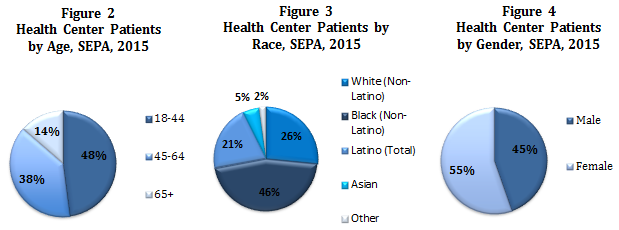
As the largest national network of safety net primary care providers, the majority of health care centers’ patient population are from racial and ethnic minority groups, are uninsured (36%), have family incomes at or below poverty (72%), and reside in either rural or economically depressed inner city communities. About 1 in 15 people living in the United States utilize health centers as their health care home.3 In Southeastern Pennsylvania (SEPA), more than 198,000 adults use a community health center or clinic as their source of regular, primary care. Among the five counties in SEPA, the City of Philadelphia (13.6%) has the highest percentage of adults who are health center patients. This represents over 136,000 adult health center patients in the City. Philadelphia is followed by Delaware (6.7%), Chester (3.9%), Montgomery (3.2%), and Bucks (1.1%) Counties (Figure 1). The majority of health center patients in all five counties are under age 44 (47.9%)4 (Figure 2), African American (45.5%) (Figure 3), and female (55.3%) (Figure 4).
Barriers to Care
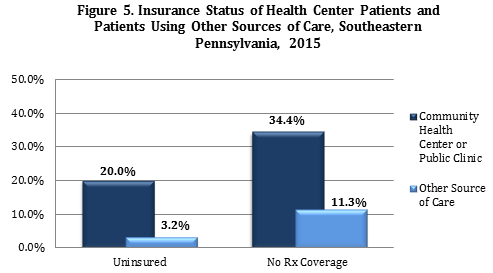
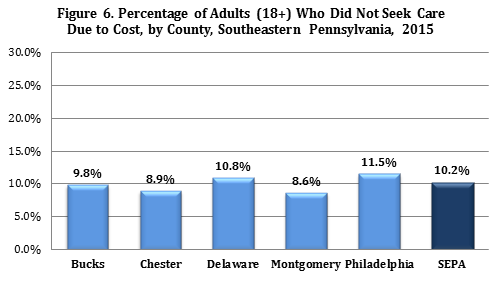
Health centers have demonstrated their ability to improve access to care and health outcomes by (1) ensuring patients have a regular source of care, (2) improving access to needed preventive services, and (3) improving health outcomes and reducing disparities. Millions of Americans have gained insurance coverage through the Affordable Care Act (ACA), and, as such, the ACA has increased funding to health centers in order to help them meet the needs of individuals newly insured through the Act. However, over 40 million people are still without health insurance, and receiving the adequate support necessary to care for these populations remains a challenge for health centers going forward.5 For example, as shown in Figure 5, uninsured adults in Southeastern Pennsylvania (20.0%) are more likely to use public health centers than adults using other sources of care (3.2%), despite the availability of coverage under the ACA. These results are consistent for prescription medication coverage, as well (34.4% versus 11.3%, respectively). The uninsured are more likely to delay seeking care due to costs, and, consequently, are at a higher risk for poor health outcomes as a result of unmet health care needs. In Southeastern Pennsylvania, 10.2% of adults (18+) did not seek care due to cost when they were sick (Figure 6); both Philadelphia (11.5%) and Delaware (10.8%) Counties are slightly higher than the regional average (10.2%). Evidence demonstrates that expanding both insurance coverage and the number of health centers are effective strategies in addressing barriers to care. 6
Outreach
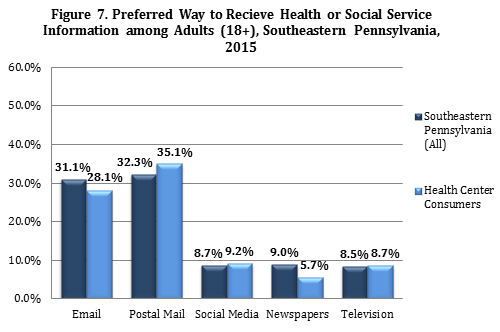
Each year, National Health Center Week recognizes the special populations served by Health Centers, as well as creates a forum to raise awareness of the Health Center model as is relates to expanding access, accountability, and cost effective care for health improvement. This year’s theme: Celebrating our Legacy, Shaping Our Future, is a reflection of these principles. The National Association of Community Health Centers (NACHC) has designed a website dedicated to Health Center Week that houses resources and tools for the promotion of health centers and the good work they are doing in their communities. One of the new topic areas added to the 2015 SEPA Household Health Survey addresses the growing quantity of health information channels that have become increasingly more available to consumers over the past decade (via internet and social media), in order to evaluate which avenues have the greatest reach in communities throughout our region. Figure 7 shows postal mail as the most preferred way to receive health or social service information among all SEPA adults (32.3%), as well as adults living in SEPA whose primary source of care is a health center (35.1%). The second most preferred option is email (31.1% versus 28.1%, respectively), followed by social media in health center consumers (9.2%) and newspapers in the general population (9.0%). This information can help health centers in SEPA communicate important information about the services and resources available to medically underserved populations across the region more effectively.
Be sure to check this site for more articles on the impact of the Affordable Care Act in SEPA in the near future! For information regarding PHMC’s Community Health Data Base 2015 Southeastern Pennsylvania Household Health Survey, please contact CHDB Project Assistant Laurel M. Jones (267.350.7697 – This email address is being protected from spambots. You need JavaScript enabled to view it.).
1,3 National Association of Community Health Centers (NACHC). (2014, March). America's Health Centers. Retrieved from Health Center Week : http://www.healthcenterweek.com/client/America's%20Health%20Centers%20March%202014.pdf
2 Pennsylvania Association of Community Health Centers (PACHC).(2015). Community Health Center PA Directory. Retrieved from: http://www.pachc.org/health_find.html
4 More private providers accept Medicare from patients age 65 and over than accept uninsured patients or patients insured through Medical Assistance.
5, 6 National Association of Community Health Centers (NACHC). (2014, March). Health Center and the Uninsured: Improving Access to Care and Health Outcomes. Retrieved from Health Center Week : http://www.nachc.com/client/documents/research/Uninsured%20FS%200514.pdf