Men's Health Week: A Look at High Blood Pressure
June 2015
As we approach National Men’s Health Week, celebrated every year during the week leading up to and including Father’s Day, it is important for us all to remind ourselves and be aware of the health risks that affect the men and boys in our lives. These risks encompass a wide range of afflictions specific and unique to males, but there are also those risks that, while affecting both men and women, have a disproportionate effect on men’s health and well-being. Among these risks is high blood pressure, which can lead to coronary heart disease, stroke, heart failure, heart attack, and kidney failure, among others.[1] Men below the age of 45 are more likely than their female counterparts to have high blood pressure, and, furthermore, according to the U.S. Centers for Disease Control and Prevention, the leading cause of death among men in this country year after year is heart disease, which comprises a number of different heart conditions, including many of those listed above.
That high blood pressure exists as a major contributing factor to these heart conditions is both good and bad. It is unfortunate because, as demonstrated below, there is a large – and growing – proportion of men with high blood pressure. That said, it can also be looked at optimistically, given the fact that high blood pressure is largely preventable with the right diet and lifestyle changes. Drinking too much alcohol, not consuming enough potassium, being physically inactive, and above all, eating too much salt are all lifestyle practices that can lead to an individual developing high blood pressure.[2]
The Community Health Data Base (CHDB) collects information on high blood pressure and a few related indicators in our Household Health Survey. In recognition of National Men’s Health Week, CHDB would like to highlight a few of these findings on high blood pressure from the 2015 Southeastern Pennsylvania Household Health Survey.
High Blood Pressure in Southeastern Pennsylvania
In the 2015 Household Health Survey, respondents were asked whether they “have ever been told by a doctor or other health professional that they have high blood pressure or hypertension”. What we have found over the last fifteen years asking this question is that there has been a fairly consistent and steady rise in the number of individuals with high blood pressure, particularly men. Figure 1, below, depicts this trend quite clearly.

Race and ethnicity also appear to have some bearing on a man’s risk of developing high blood pressure. With 43.8 percent reporting ever having been told by a doctor that they have high blood pressure, black men appear to be at the highest risk of developing the condition. Of white men, 33.6 percent have been told they have high blood pressure, while only 16.7 percent of Asian men report having been told the same.It is also worth noting that one of the most substantial increases took place between 2012 and 2015, with nearly 3 percent more men developing high blood pressure in the past few years. This upward trend could be attributed to a variety of factors, and is correlated with conditions that are widely considered to be related, such as obesity, which has also been on the rise in recent years. In fact, due partly to a rise in childhood obesity, high blood pressure is becoming increasingly common in children and teenagers as well.[3]
Sodium Awareness
Being aware of and watching one’s salt intake is an important part of preventing, and managing, high blood pressure. The U.S. Department of Health and Human Services recommends limiting one’s daily consumption of salt to no more than a teaspoon a day to help control high blood pressure.[4]
In the 2015 Household Health Survey, new questions pertaining to sodium consumption and awareness were added to gage whether residents of Southeastern Pennsylvania are aware of the risks of eating too much salt, and, moreover, whether they were making any efforts to mitigate those risks.
Among other questions on salt consumption, respondents were asked: “Are you currently watching or reducing your sodium or salt intake” and “In your opinion, how harmful, to your health is eating too much salt/sodium”. Figure 2, below, looks at the percentage of men with high blood pressure who are not currently watching or reducing their salt intake, and, in addition, the percentage who do not think that eating too much salt is very harmful to their health.
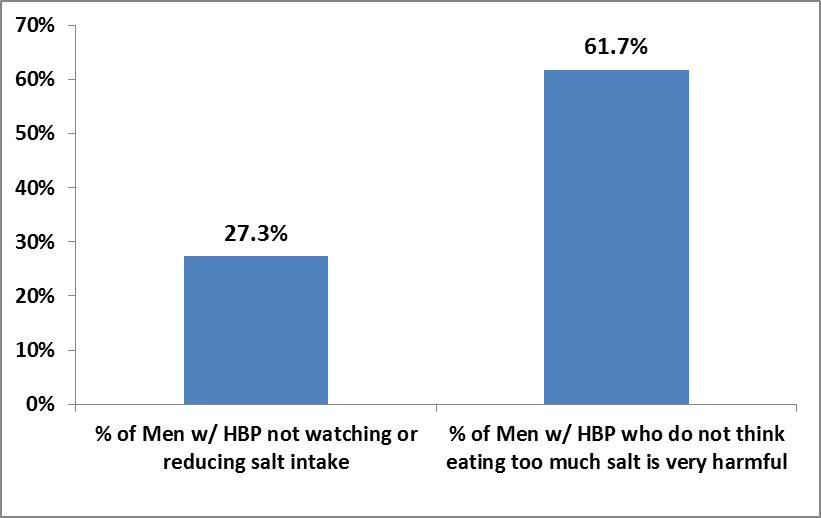
Given the fact that this is one of the simplest and most straightforward ways to lessen the severity and negative effects of high blood pressure, it is worrisome that, of men with high blood pressure, 27.3 percent are not currently watching or reducing their salt consumption. It is, however, very likely the case that this is due in part to 61.7 percent of men with high blood pressure not believing that eating too much salt is very harmful to their health in the first place. That is why, as we approach National Men’s Health Week, it is incumbent upon all of us to share our awareness of the risks of eating too much salt, especially with the men we know and love.
For information regarding PHMC’s Community Health Data Base and the 2014/2015 Southeastern Pennsylvania Household Health Survey, or to learn more about high blood pressure data or other men’s health indicators, please contact CHDB Project Assistant Kyle B. Loder (215.985.2525 – This email address is being protected from spambots. You need JavaScript enabled to view it.) or Laurel Jones (267.350.7697 – This email address is being protected from spambots. You need JavaScript enabled to view it.).
[1]U.S. Department of Health and Human Services, National Heart, Lung, and Blood Institute., http://www.nhlbi.nih.gov/health/health-topics/topics/hbp.
[2] Ibid.
[3] U.S. Department of Health and Human Services, National Heart, Lung, and Blood Institute., http://www.nhlbi.nih.gov/health/health-topics/topics/hbp.
[4] Ibid.